Sunday, December 9, 2012

The Status Quo Is On Notice


Over the last quarter, I’ve talked about several economic issues. I discussed the financial crisis in I Got Mugged OnWall Street, how Oligopolies Can Be As Bad As Monopolies, why measuring presidential performance shouldn’t be measured by the unemployment rate, looked corporate lobbying in The EconomicAquarium, and work life balance in I’m Too Busy To Be Happy.

Embedded in all these posts are my opinions on various issues. Looking back, I see a major theme: how the powerful are able to retain power and maintain the status quo. The powerful entities around us have several tools at their disposal, and they’ve designed the system to be very hard to change. But, change is in the air, and not admitting it will be detrimental to these entities.

There are several examples to illustrate this. Toyota is a market leader in hybrid cars. They didn’t get there out of luck; they had the foresight to develop this technology before it was popular. In contrast, GM put no effort or value into hybrid technology, even as it was emerging from Japan. This lack of foresight cost them and they’re just now getting competitive in this space. Instead of fighting fuel economy standards and ignoring the inevitable rising trend in fuel prices, they stuck their collective fingers in their ears and lobbied against more aggressive fuel economy standards.

We’re seeing history repeat itself today with solar technology. Germany and China are becoming world leaders in solar panel production. Solar technology just at the beginning of becoming a huge industry, and these countries are positioning themselves to be leaders. It appears that China is even undercutting themselves now to gain market share- a move that shows they see the long term gain to be had. The US is probably going to regret passing on this opportunity.

A potential game changer in the financial industry is the Rolling Jubilee. This has the potential to break the financial system. Today, debt is bought and sold with no thought to the terms of the underlying mortgage contract that provides the income stream. There’s no reason you can’t buy some debt (in many cases for far less than its original cost). The Rolling Jubilee buys some of the worst debt, for the cheapest cost, and simply relieves the debt.

Now imagine that this takes off in a big way. This could fundamentally break the mortgage market. This is because the incentive to pay a mortgage goes away if not paying is rewarded with the debt being erased. It may seem far-fetched today, but if this movement gains traction, the banking industry would be wise to take notice.

The modern sustainability moment is a game changer in a big way and anyone or thing that doesn’t recognize it is going to regret it. Those that deny this change will be left behind like GM was to Toyota and Honda.

Sunday, December 2, 2012

I'm too busy to be happy


We Americans work ourselves to death. We work over 1800 hours a year (http://www.bloomberg.com/news/2011-11-03/americans-work-too-much-for-their-own-good-de-graaf-and-batker.html). That’s only amounts to 36 hours per week if you assume everyone gets a 2-week vacation. But, that’s 28% more time than our counterparts over in The Netherlands. That’s insane! Imagine if you got an extra 400 hours of time off a year. If I had that, I think my parents might not mind my living so far away.

Obligatory picture of a windmill that must accompany any mention of Holland.
So, why do we do this to ourselves? Well, it seems to have something to do with the American Dream. We, collectively, seem to be focused on improving on our individual situations for our kids. The weird thing is there are plenty of us where that doesn’t apply.


 Portland: where young people go to retire. It’s funny because it’s absurd. But, is it really?

The irony here is that the country’s direction is more present minded than ever before. The government is actively doing things that benefit the present at the expense of the future. As an example, we have no interest (politically) in actually fixing our nation’s infrastructure that is crumbling before our eyes. http://abnormalecon.blogspot.com/2012/11/investing-in-future-is-no-longer-part.html

Minnesota I-35W bridge collapse. One theory: all Michael Bay’s fault.
I think many of us kill ourselves for a career because we’ve never thought to do anything else. After all, financial success is life success. Or, so we’re told. How else are we expected to produce a better life for our kids, who can be expected to work themselves to death on their own?

Maybe we just need to chill out, and follow the sage advice of one Farris Beuller:
“Life moves pretty fast. You don’t stop and look around once and a while, you could miss it”. –Ferris Beuller


My point here is the focus on financial success. Because it is the measure of success, we have optimized our lives around that metric. I don’t know many people who are truly satisfied with the result. Ask around and find someone who is perfectly content working as many hours as possible with no regard for their personal life.

Clearly, our measure of success isn’t really making us happy. Even worse, it seems that a focus on financial success causes unhappiness. This report (http://www.usnews.com/news/articles/2012/05/22/americans-are-the-wealthiest-but-not-the-happiest) shows that even though Americans are indeed the wealthiest on average, the Better Life Index shows that we’re in the middle of the pack when it comes to happiness.

Let’s be fair that finances play a part. It’s hard to feel like you have a good life if your main daily concern is getting enough food to live. Or less extreme, just making enough (from working all waking hours) to barely provide for yourself or your family. What I’m saying is that it’s just not the only metric that should be considered.

The Better Life Index is one alternative measure to financial success. But, what should we look at? Let’s assume that we can pick a new metric, but whatever we pick will be obsessed about to the point that we will give up any other goal in its pursuit. I think it’s a safe assumption; after all, that’s why we have the least amount of time off and are expected to work to almost 70 years old. http://www.nytimes.com/2012/07/22/opinion/sunday/our-ridiculous-approach-to-retirement.html?_r=0

I submit that we need to at least consider income disparity when measuring national success. We can claim the highest average income of all industrialized nations, but almost everyone is under that average. This is because those at the top can have a very strong pull on the average upward. We have one of the highest income inequalities in the industrialized world (http://en.wikipedia.org/wiki/Income_inequality_in_the_United_States#International_comparisons). This means that we see more people per capita struggling at the bottom than many other countries. So, even though we have the absolute income crown, most of us don’t benefit from that. What’s worse, this measure is trending in the wrong direction.
Gini coelfficient of the US historically, a common metric for income inequality (higher is more inequality).

Ideally, we'd more directly measure happiness. Because, well, isn't that what we're ultimately after anyway? Money doesn't buy happiness, but happiness does. This is a tricky proposition, because it's ultimately subjective and much harder to see a direct cause and effect. But, at least it'd be a step toward paying attention to a metric that benefits everyone.


Sunday, November 11, 2012

The Economic Aquarium


In a previous post, I talked about how corporations are like “sharks with freakin laser beams attached to their heads.” I explained that this was due to a shark’s nature as a very efficient predator in its environment.

The reason I say that corporations take this a step further (with lasers) is because of their market power in our global economy. Weeks ago, we studied the difference between efficient free markets and monopolistic markets of different types.

I would imagine that most Americans are in strong favor of a free market economy. It turns out that, while it’s true that a majority of Americans do indeed feel this way, it’s not a strong majority (around 60%) and it’s declining.

Source: globalscan.com


 In a truly free (and completely theoretical) market, the price of any good should eventually be it’s cost. That is to say, market competition drives the price down to the point where there is no profit. Clearly, in many areas of our economy, that isn’t happening. It’s clear because we’re seeing record profits year over year for several companies, many of which should be competing against each other and we should see the opposite trend.

That suggests to me two things. One, that major parts of our economy operate in a more monopolistic/oligopolistic manner than a free market manner. And two, that when Americans are asked about how they feel about free markets, that they are really opining on the monopolistic side of the market because it’s the more visible and discussed part of the economy.

Suffice it to say, we are seeing a large part of our economy with market power instead of without it (the definition of a monopolistic market). However, if it ended there, I would call that a shark, not a shark with lasers. That’s because a shark can have market power, fighting off all competition easily, but it doesn’t do this by manipulating its environment. It’s just really good and working with the environment it lives in.

However, nowadays we’re seeing corporations flexing a lot of market power in the policy arena.  Between lobbying and campaign contributions, we’re seeing billions of dollars spent on openly persuading our government. The oil industry alone spends hundreds of millions of dollars on lobbying.

This is what I’d call sharks with lasers. The sharks are trying to get those that control the environment to give them an advantage. They aren't content with being the biggest and best in the economic waters; they need to actively (and in a sense artificially) manipulate their environment to be even better.

If the government is what defines the economic environment, I’m not saying it should be blind to the creatures living in it. The government needs to be aware of all the creatures in the economic pool, and produce an environment that keeps all them as healthy as possible. It’s easy to pay attention to the big things in the tank, but to maintain a healthy ecosystem, you have to pay more attention to the bottom of the food chain.

There's more than sharks in the water. (www.newyorksocialdiary.com

What gets measured gets managed. The government (and the punditocracy) measure economic health by GDP. The flaws in this method are widely discussed and debated, but the idea in this metric is to try to measure the overall health of the economic environment. And, given that it’s the most visible metric we use, it’s no surprise that the government et all pay attention to it. And, if you want to change the GDP number as fast as possible, it’s probably best to focus on where you can make the biggest difference. So, it’s not surprising that the biggest entities in the economy are targeted first- they’re the lowest hanging fruit (and I’m going for a record number of mixed analogies). Ensuring that giant corporations are successful is a clear leverage point, but it's probably not the most effective one.

This is where I think we need an economic policy change. In the economic food chain, it’s more effective to feed the plants and let the rest of the ecosystem work naturally than it is to feed the sharks directly. Feeding the sharks is trickle down economics (don’t try to visualize that one), where as feeding the plants would be trickle up economics (and there has to be a better term for that).

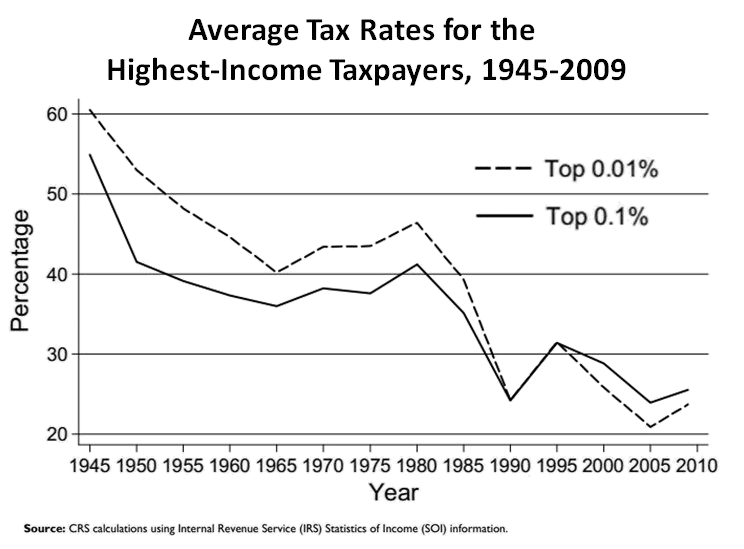
I believe the reason trickle down economic policies worked under Reagan is because there was huge leverage. The government was able to reduce the highest income tax rates by roughly half. So, this had a positive effect because of the shear size of the amounts involved. However, that leverage is far more limited now. Because the effective tax rates are so much lower today than they were at the beginning of Reagan’s presidency, we can’t create as big of an effect with the same policy (and certainly can’t afford it either!).

Huge drop for the top earners, and it worked... once. (Source: Wikipedia)

In addition, claiming that the top taxpayer’s pay more than their fair share (a common claim from conservatives) falls flat with me because income inequality is increasing. The people with the most money are the experts and amassing it, even when they have to pay more than their fair share. So, let’s use their keen ability to amass wealth to everyone’s advantage. To stimulate the economy, let’s give a break to those that are worst at amassing wealth and let the experts do their thing. While economic nature takes its course, those dollars will go round and round the economy, pushing that all important GDP up.

Trickle down today. (Source: Tumblr)

 And, just so you don’t think I’m not aware of what I’ve just done with the shark analogy:

Source: Everyday Theology

Sunday, November 4, 2012

The Unemployment Non-Story


It’s election season, and by now, if you haven’t made your decision, you haven’t been paying attention. This election is the most important in our nation’s history; at least that’s what we’re meant to believe from watching cable news. Don’t get me wrong because I do believe this is an important election, but not really for any of the reasons that are actually talked about. Alternatively, some things that are talked about can’t be changed, and certainly not by any difference in each of the candidate’s policies.

Consider, if you will, all the coverage on climate change. Even after hurricane Sandy, very little has been said by Romney or Obama on the subject (the argument over a single hurricane being evidence of global warming notwithstanding). This is one of the most important issues to address, or at least talk about. However, the discussion on this topic is pretty much boiled down whether or not climate change exists or not.

I didn’t actually intend to write an entire post on climate change because such a post would either be read by those who generally agree or ignored by those who don’t. Unfortunately, too many people have their ears closed for that one.

I’m more interested in the latter- the things we hear about endlessly, with virtually no chance of relevance. The unemployment rate is a prime example. Romney said Obama said unemployment would be 5.4% by now. Who said what and when in what context isn’t relevant here, this claim has gone around the fact checkers and I’ll leave that to them. Today’s unemployment rate is about 7.8%. So, the big question- what is a reasonable best-case scenario for the unemployment rate in 4 years? Both candidates talk about changing unemployment, but it’s not an easy thing to change, and certainly not something that’s changed quickly.

It doesn’t really matter who you think will do a better job of this, because outside of a fundamental change to economic policy (very likely a bigger change than either candidate is willing to actually put in place), we won’t see the behavior of unemployment change.

Take a look at the following graph. It shows the unemployment rate over the last 50 years. We’ve seen some massive swings, and several recessions are readily apparent. Mind you, completely unmathmatically, I highlighted the ups and downs on this graph. Notice that in almost all cases, the unemployment rate goes down slower than it goes up.


Bureau of Labor Statistics
For example, in 2001, the unemployment rate went from 4% to 6% in roughly 18 months. It took 3 years for it to drop down to a new low of 4.5%. The important point is that a drop in unemployment takes longer than a raise.

Fast forward to the financial crisis, which shows a raise in unemployment that we really haven’t seen since the great depression. It took just over two years to go from around 4.5% to 10% in late 2009. It’s a large crisis not only for the large amount but also how fast it happened.

In the last 50 years, unemployment has dropped at about 2% over 4 years. And, given that the peak happened in late 2009, an unemployment rate of 7.9% is well in line with historic trends.

So, as this election has largely focused on what the Obama administration has done about unemployment, it would seem that they’ve done about the same as every other administration in the last 50 years. Or, how a Republican congress has obstructed the administration has actually tried to do, then blamed the administration for inaction.

That’s not exactly news worthy of arguing over during election season, is it? Can we wrap up this fight and talk about something that we can actually do something about now?

Sunday, October 28, 2012

Oligopolies Can Be As Bad As Monopolies

One of our government's roles is to protect the business environment from monopolistic behavior which undermines the free market. This is a necessary role to protect consumers and the efficiency of the free market. The Sherman Antitrust Act was the first law put into place allowing the federal government this enforcement. But, with the recent political environment of less government, at least in economic matters, we’re seeing several examples where lack of enforcement has likely led to harmful practices and market behavior.

There are many examples of monopolies being dealt with in US history. Well known ones include Standard Oil, AT&T in the 80’s, and Microsoft in the 90’s.

The bigger challenge in today’s economy is the oligopoly. When a single entity manages to get enough market power to break the efficiency of the market, it’s generally clear that for assessing blame, and it’s (relatively) clear to consumers. An oligopoly is a lot harder to see, because there isn’t a simple causal relationship in place.

The government was able to establish that AT&T was abusing its market power, and addressed it by getting AT&T to break up into the “Baby Bells.” It was clear that AT&T had enough market power on its own to justify these actions. How do you establish that market power is being abused when no single entity has enough market power to control the market on its own?

In the 70’s the OPEC countries formed a successful cartel, putting price controls in place which significantly raised prices. Yet, no single OPEC member could have done this alone (a good reason why the cartel didn’t last). It was clear that market power was being abused because the OPEC members weren’t secretive about it. For a similar situation in the U.S., this would be illegal, so there’s a greater incentive to stay covert. Hence, much harder to establish abuse of market power.

Today, and more importantly, in 2008, the financial industry was run by a couple very large banks. The bailout of these banks was justified due to these companies being “too big to fail.” Being too big to fail, as in being critical to the economy, so much so that the government will pay to avoid a complete failure isn’t in itself an abuse of market power. (There are other issues with this system, but market power abuse isn’t inherently one of them.)

These companies are still acting as an oligopoly though. In a competitive market, these financial companies should have to deal with a bunch of startups (in a free market, new entities are free to enter or leave). Another property we would expect to see if the financial industry isn’t operating as an oligopoly would be price pressure from competition from one another. Norm touches on this in this post. Showing that these firms are able to charge $3000/hr for their services in some cases. That’s quite a premium to see where there are neither new entities entering the market nor existing competitors undercutting that price.


Neil Barofsky, special prosecutor overseeing TARP funds was interviewed by Bill Moyers about his experience with dealing with the big banks. He makes a very good point about a market failure regarding bailout funding. Because there is a presumption of bailout, the big banks are seen as very safe investments, so they get preferential treatment and higher credit ratings as a result. He suggests that breaking up the big banks would be the best approach to this problem.

As I mentioned in my previous post, not a whole lot of restriction was put on the big banks that needed bailout money. As a long-term solution to this too-big-too-fail issue, establishing that the big banks are acting as an oligopoly, this might be a good way to create some more competition and reduce the market power of these big banks. At the same time, reducing the size of these entities would reduce the risk to the economy when one of them fails, thus not needing to bailout failing companies in the future.

Sunday, October 21, 2012

I Got Mugged On Wall Street

The biggest leap of fiction in Wall Street
is that Gordon Gekko actually went to jail.
In 2007, the financial crisis produced a recession we haven't seen since the Great Depression. There isn't a single reason this happened. This was a system failure. Much like a classical engineering disaster, many things had to go wrong to produce such a huge problem. However, one of the most egregious failures was that of the greed by those working for large investment banks to take advantage of the situation.

The political environment is very strange. Not a single person has gone to jail for actions regarding the financial crisis. Not only that, when several large companies needed to get bailed out, no restrictive actions were tied to the money. Executives were still allowed to get ridiculous bonuses, the banks were never required to make new loans. At the same time, there was political pressure for government to get out of the way, as in, they shouldn't be in the business of business. We have a political environment where there is a significant push to protect people who essentially stole billions.

Even in cases where there is at least an attempt at prosecution, the rich are so insulated that it's almost impossible to punish them. In Norm's post on Asymmetric Reward System, he highlights the fact that when the SEC prosecuted the CEO of Countrywide for $100 million. However, he took home hundreds of millions of dollars and ultimately had to pay $26 million in fines.

In the Matt Taibbi's Rolling Stone article "Why isn't Wall Street in Jail?", he makes the case that SEC does more to protect those committing financial fraud far more than prosecuting them. There are clear examples of wrong-doing, with plenty of evidence to back it up. Yet, the SEC drags its feet.

You can't blame a shark for attacking a person, the shark is a predator and such attacks are in its nature. I see corporations the same way- they are designed to extract profit from the environment as efficiently as possible. And ultimately, there's no blame in that, it's in the nature of a corporation to act this way. However, a shark doesn't have direct control over its environment. It seems like (some) corporations are more interested in changing their environment so that they are the most efficient predator by definition. Corporations aren't the sharks of capitalism anymore. They're the sharks with freakin laser beams attached to their heads. (I could keep this going, with a great comparison of wall street banks with Dr. Evil, but I leave that as an exercise for the reader).


Regulation gets in the way of the banking system. It's in the banks' self-interest to act appropriately, and the government just gets in the way. The poor banks just needed for regulation to get out of the way because it was stifling their ability to be benevolent stewards of an efficient, well-oiled market economy. At least, that's how the now defunct Office of Thrift Supervision saw it.

OTS cutting red tape (their own regulatory code) with a chainsaw
These companies get to pick their preferred regulators. That's not the same as no regulation at all, but it's not far off. Imagine if in baseball the Yankees got to choose their own umps. Do you think they would go out of their way to ensure that these umps are going to hold a fair game? What if one group of umps wants the job and promises to look the other way or purposefully change the strike zone? In 2003, the Office of Thrift Supervision, one of the banks' choices for regulation, championed the position of cutting away as much regulation as possible. These are supposed to be the guys looking out for the health of the financial system. Instead, they're looking out for the health of these banks. The ability of banks to choose their regulator is essentially making the regulators compete against themselves. And, the competition is for who can be the worst at regulating. This is what I consider a slight conflict of interest.

But, can you blame them? The people involved in this whole scheme walked away with billions. And, when not a single person gets punished, when you can buy off the government to not enforce the rules what's the down side? I think that if it were common knowledge on what all went on here, you'd see a lot less sympathy for businesses and free market principles. And, Occupy Wall Street might not be considered a "fringe" group. We were all lied to. We are all affected by this. And yet, barely a thing was done to punish those involved or ensure this never happens again.


Tuesday, October 9, 2012

BVD Experience

What is BVD?

BVD stands for Brainstorm, Vote, and Discuss. This is a process to narrow and focus on a specific solution. The idea being that there are likely to be several solutions, and trying to adequately discuss all of them is very difficult and unproductive, especially when there are time constraints.

First, the teams brainstorms on an open question, but one that hopefully can lead to direct action. Then, all the ideas are collected on a whiteboard or some central location and each team member votes for his or her top two choices. Finally, the direction for the rest of the meeting is dictated by the popular choices.


Brain-storm


Vote

Discuss